
Michael Chapman
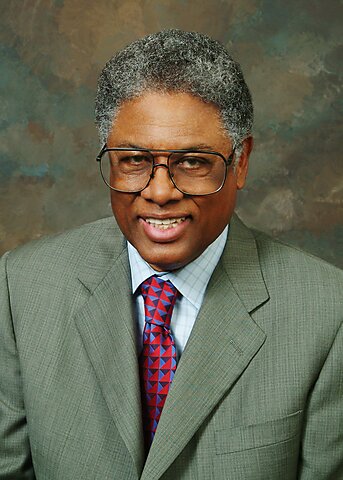
Thomas Sowell, who turns 96 on June 30, is the embodiment of the self-made American. He was born in the segregated South, dropped out of high school, served in the Marines, earned a GED, and went on to earn degrees from Harvard, Columbia, and the University of Chicago. Nobel laureate Milton Friedman referred to him as a “genius,” while Cato Senior Fellow Gerald P. O’Driscoll said he “is one of the most important economic and social thinkers of the last 50 years.”
Through dozens of books, essays, and interviews, Sowell has promoted classical liberal economics and individual liberty. Like Bastiat and Hazlitt, he wrote primarily for general readers yet earned the praise of economists Hayek, Friedman, and James M. Buchanan. As America marks its 250th anniversary, it is fitting to honor a life that exemplifies the promise of the American experiment.
Sowell was born in Gastonia, NC, in 1930. His father died before he was born, and his mother passed away a few years later. He was raised by a great aunt. In his home, there was no electricity, central heating, or hot running water. When Sowell was eight, the family moved to Harlem. From there into his twenties, Sowell learned from the “school of hard knocks,” as Jason Riley reports in Maverick: A Biography of Thomas Sowell.
“It gave me a lasting respect for the common sense of ordinary people, a factor routinely ignored by the intellectuals among whom I would later make my career,” said Sowell.
In 1951–52, Sowell served in the Marine Corps. He was trained in military photography, and the skill became a lifelong passion. After his discharge, he studied at Howard University before transferring to Harvard, where he graduated magna cum laude in economics in 1958. He then earned a master’s degree at Columbia (1959) and a Ph.D. in economics at the University of Chicago, studying under Milton Friedman and George Stigler and taking courses with Gary Becker and Friedrich Hayek.
Although Sowell identified as a Marxist in college, a 1960 summer job at the US Labor Department, where he witnessed government inefficiency firsthand, shifted his views. “[T]he experience of seeing government at work from the inside and at a professional level started me to rethinking the whole notion of government as a potentially benevolent force in the economy and society,” said Sowell.
After Chicago, Sowell taught at several leading universities, including Cornell, UCLA, and Stanford, before joining the Hoover Institution in 1980, where he has remained a senior fellow ever since. At Hoover, he was able to devote himself fully to research and writing on the topics he chose.
Sowell’s writing and lectures have been breathtaking—at least 46 books since the 1970s. Commenting on his erudition, AEI Senior Fellow Emeritus Mark Perry said, “I don’t think there is any writer today, economist or non-economist, who can match Thomas Sowell’s ‘idea density’ and his ability to consistently pack so much profound economic wisdom into a single sentence and a single paragraph.” Because of his ability to explain complex economic facts in simple, down-to-earth prose, Sowell has helped spread free-market ideas worldwide, especially among young people.
“The younger the audience, the more they love Tom Sowell,” Peter Robinson, host of the online program Uncommon Knowledge, told Jason Riley. “Tom is the most appreciated, the most enjoyed, the most requested guest.”
Among Sowell’s most influential books is Knowledge and Decisions (1980), which Hayek hailed as “the best book on general economics in many a year.” Author and journalist M. Stanton Evans said the book “should eventually take its place alongside the writings of Mises, Hayek, and Friedman as a defense of economic (and other) freedoms.”
Other valuable books include A Conflict of Visions (1987), which explores the philosophical roots of political conflict; Basic Economics (2000), which has introduced thousands of readers to economic reasoning; The Housing Boom and Bust (2009), an analysis of the financial crisis; and Social Justice Fallacies (2023), a critique of one of today’s most influential political ideas. Together with more than 40 other books, they have made Sowell one of the most widely read public intellectuals of the last half-century.
In addition to his book output, Sowell wrote a weekly column for Creators Syndicate for 25 years, which ran in more than 150 newspapers. He has received many awards for his writing, including the National Humanities Medal and the Bradley Prize for intellectual achievement.
Harvard professor Steven Pinker, who has known Sowell for years, calls him “one of the most brilliant people I’ve come across and one of the deepest thinkers,” adding that he is among the most underrated authors of our time. Historian Paul Johnson described him as “the most interesting philosopher at work in America.”
Economist, author, and professor Glenn Loury says Thomas Sowell is “an epic figure of the 20th century. One of the great intellectuals of our lifetime.”
Nobel laureate James M. Buchanan, a distinguished senior fellow at the Cato Institute, put it most simply: “We’ll still be reading Sowell a hundred years from now.”
Jason Riley adds, “Sowell has spent a career putting truth above popularity. We need a hundred more just like him.”
As America marks its 250th birthday, Thomas Sowell stands as a living example of the country’s promise: that talent and hard work can overcome circumstances of birth. From a childhood in segregated poverty to studies at Harvard, Columbia, and Chicago and a career of influential scholarship, Sowell embodies the self-made American. His life proves that the American dream is real.
Happy birthday, Thomas Sowell!